
Search for coco bristle pricing and you’ll run into two kinds of listings. One quotes $968 a metric ton, FOB, 8-ton minimum. The other just says “price on request” and leaves you to email a stranger and wait three days for a number. Neither tells you whether that $968 is a good price, a bad one, or completely beside the point for the grade you actually need.
It’s beside the point more often than buyers realize. Coco bristle doesn’t trade in one market — it trades in several, stacked by grade, and the number changes a lot depending on which one you’re actually buying into.
We sell coco bristle fiber out of our own plantation, so we spend a fair amount of time explaining this exact confusion to buyers before a quote even goes out. Here’s the breakdown.
Coco Bristle vs. Coir Fiber Price — Why They’re Not the Same Market
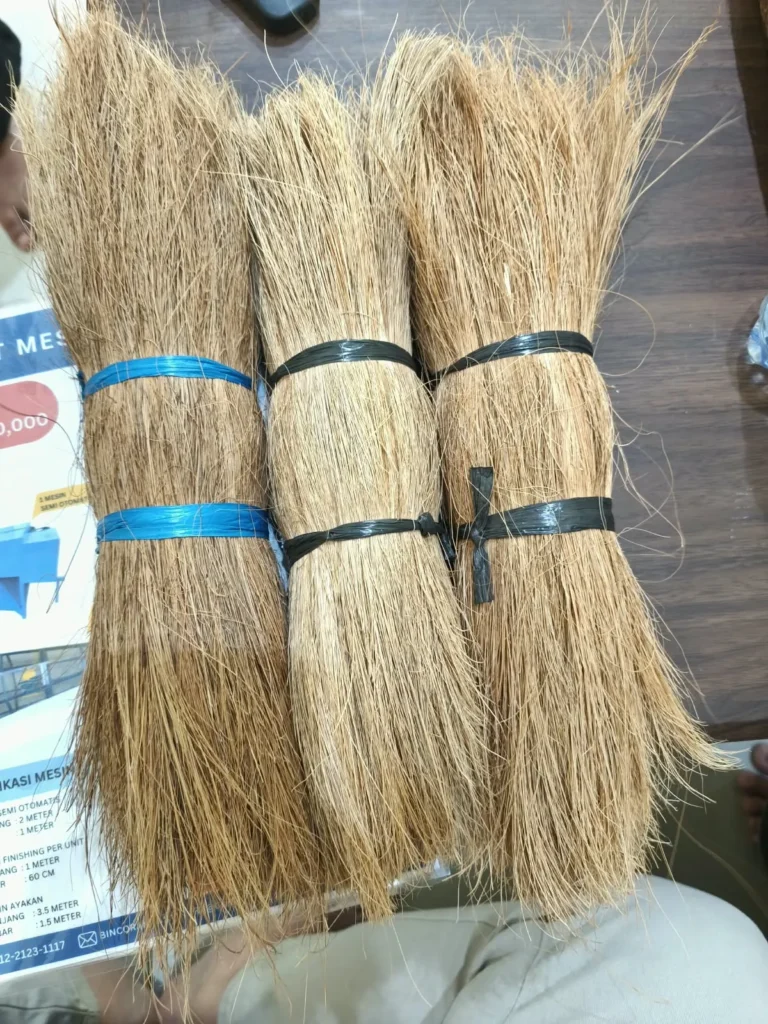
Coco bristle fiber, sold FOB Indonesia, typically runs several times the price of short coir fiber — because they’re different products serving different buyers, not two grades of the same thing. Bristle is the long, stiff fiber used in brushes and brooms. Coir fiber is the short, mattress-padding material. Mixing up the two when comparing prices is the single most common mistake we see.
Here’s where that shows up in real numbers. General short coir fiber — the kind used for mattress and upholstery padding — trades around $220 to $350 a metric ton FOB. Bristle fiber, the long stuff, sits in a completely different bracket: historical regional data (Sri Lanka’s APCC/ICC trade reports, admittedly from 2016 and 2019, so treat these as directional rather than current) puts 1-tie bristle around $552 to $670/MT and 2-tie bristle anywhere from $759 up past $1,000/MT. A current Indonesian listing we found quotes $968/MT FOB at an 8-ton minimum — squarely inside that bristle range, nowhere near the coir range.
So if a supplier quotes you something in the low $200s per ton for “coco fiber,” ask them point-blank whether that’s bristle or short coir. It’s an easy question that saves you from ordering the wrong product entirely — which, for a brush manufacturer, means fiber that’s too short and too soft to hold a bristle shape.
What Tie Grading Does to the Price
The industry sorts bristle into tiers — commonly called 1-tie, 2-tie, and 3-tie — based on cleanliness, fiber length, and stiffness. We covered the mechanics of that grading system in detail in our coco bristle comparison guide, so we won’t repeat the whole explanation here. What matters for pricing: higher ties (cleaner, more uniform, stiffer fiber) cost more, and the price spread between tiers isn’t small. Historical data shows close to a 2x gap between 1-tie and 2-tie pricing in the same market. That’s not a rounding difference you can shrug off — it’s the difference between a quote that fits your budget and one that blows past it, depending entirely on which tier you actually asked for.
A supplier who quotes you one number without asking which tier you need either isn’t paying attention or is quietly defaulting you to whichever grade they have sitting in the warehouse. Ask for the tie grade by name.
What Else Moves the Price
Tie grade does the heaviest lifting, but five other things shift the number too.
| Factor | Effect on price |
|---|---|
| Moisture content | Lower, more consistent moisture means less risk of mold in transit — suppliers who test for it charge more |
| Color and cleanliness | Uniform dark-brown fiber with minimal dust or short-fiber contamination sits at the top of its tier |
| MOQ / volume | Container-scale orders price lower per ton than small lots — the 8-ton listing we found is a fraction of a full container |
| Trade term | FOB covers the product to the port; CIF bundles in freight and insurance, and the two numbers are never the same figure for the same goods |
| Port of loading | Different Indonesian ports carry different base logistics costs baked into the quote |
| Baling format | Tightly compressed bales fit more fiber per container than loose-baled stock, which changes the effective freight cost per ton even when the raw material price is identical |
None of these move the needle like tie grade does. But stack two or three of them — low MOQ, inconsistent moisture, CIF instead of FOB — and a quote that looked expensive at first glance starts making a lot more sense.
Container Math for Coco Bristle Shipments
Bristle fiber is lighter and bulkier than cocopeat, so a container load runs smaller by weight than you’d expect from a denser product. A 20ft container typically carries somewhere in the range of 10 to 14 metric tons of baled bristle fiber before it’s space-limited rather than weight-limited — bristle fills up the box before it maxes out the weight allowance. A 40ft container roughly doubles that, landing somewhere around 20 to 26 MT depending on how tightly it’s baled.
Run that against the $968/MT listing and a full 20ft container lands somewhere between $9,700 and $13,500 for the product alone, before freight and insurance get added. At CelebesAgro’s stated pace of 10 containers a month across our product lines, that’s the kind of volume that, multiplied out, puts real pressure on a supplier to keep grading consistent shipment after shipment — not just quote low once to win an order.
Why Quoted Prices Can Vary 2–3x Between Suppliers
Tie grade and trade terms explain some of the spread. The bigger reason, though, rarely makes it into a quote email: where the raw bristle actually came from before it reached the exporter.
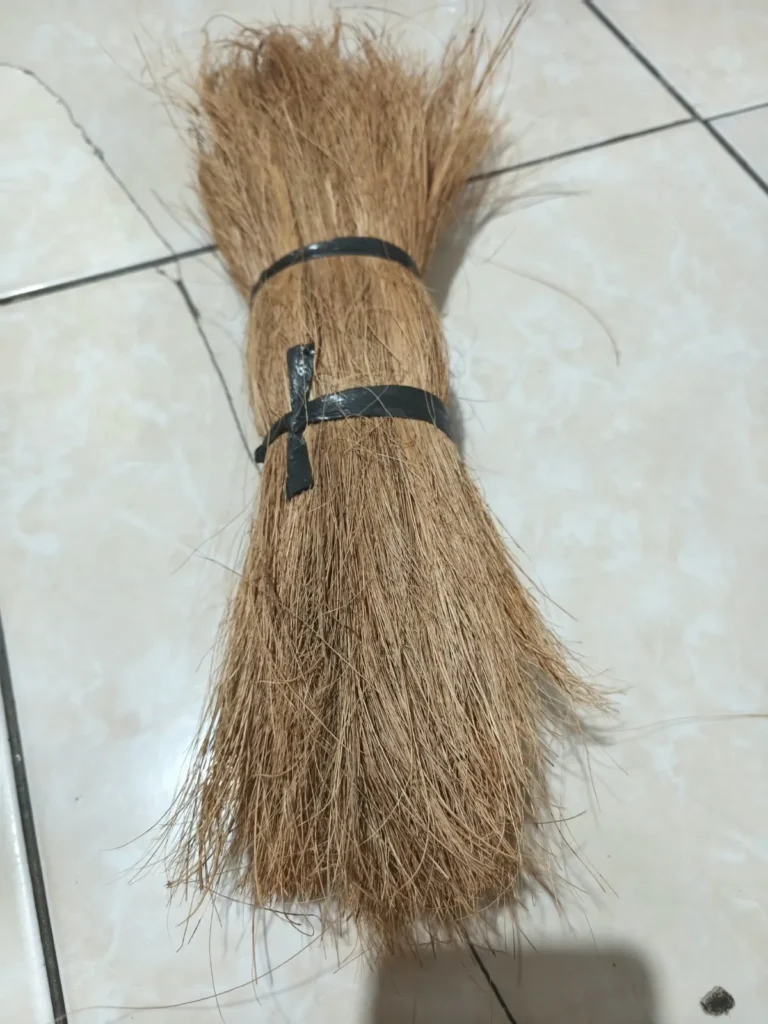
A lot of bristle on the export market gets pulled together from smallholder processors — small operations retting and decorticating husks by hand or with basic equipment, selling raw bristle up the chain to a trader who bales it and ships it under one listing. The retting time, the decortication method, even how long the fiber sat before baling — all of that varies operator to operator, which means the bristle inside one bale can be noticeably different from the bale next to it. Buyers who’ve opened a container and found the fiber stiffer or shorter than the sample they approved have usually run into exactly this.
We don’t source that way. CelebesAgro runs bristle production through our own 1,300-hectare plantation and a vetted local partner network, which means the retting and decortication process stays consistent from one shipment to the next instead of depending on whichever smallholder had stock that week. You can read more about how that sourcing actually works on our coco bristle product page.
That’s also why the cheapest quote on paper isn’t automatically the best deal. A trader-sourced bale priced 20% below ours might save you money on the invoice and cost you a rejected shipment on the other end if the tie grade doesn’t hold consistent.
Getting the Grade You’re Actually Paying For
Before you commit to a quote, confirm two things in writing: the tie grade and the HS code the shipment will be declared under. Coco bristle and short coir fiber fall under overlapping HS headings, and a shipping description that just says “coir fiber” without specifying bristle has caused real customs delays for buyers we’ve talked to. We laid out the exact codes and the classification mix-up in our export documentation guide — worth a read if you’re lining up paperwork alongside a price quote.
A Buyer’s Checklist Before You Accept a Quote
Most of the bad surprises in a coco bristle order trace back to something that was never confirmed in writing before the deposit went out. Before you accept a quote, get these five things stated explicitly, not implied:
- Tie grade confirmed by name — 1-tie, 2-tie, or 3-tie, not just “bristle”
- Moisture content stated as a tested figure, not just “dry”
- MOQ that matches the volume you actually need, not a number picked to make the per-unit price look lower
- FOB and CIF quoted as two separate figures, so you can compare against your own freight rates
- HS code specified in writing, matching bristle rather than general coir fiber
None of this takes more than one follow-up email. It just means the price you agreed to and the shipment that shows up are actually describing the same product.
Why CelebesAgro Prices Are Quote-Based, Not Listed
Our coco bristle product page says “available upon request” instead of a number for the same reason the price swings so much across this whole market: tie grade, moisture spec, MOQ, and trade terms all move the final figure enough that one listed price would be wrong for most buyers who read it. We also haven’t published our own fiber-length or moisture numbers yet — not because we’re hiding anything, but because we’d rather confirm a number once than publish one and walk it back later.
What we can commit to without a quote: Sucofindo-inspected material, processed through our own plantation and partner network rather than a trader’s blend, at a scale built for 10 containers a month without the batch-to-batch inconsistency that comes from buying smallholder bristle on the spot market.
Tell us the tie grade you need, your MOQ, and your destination port, and we’ll quote against it directly. Message us on WhatsApp and we’ll get you a number that actually matches what you’re ordering.