
Type “cocopeat wholesale price” into a search bar and you’ll get three different pictures of the same product. One listing quotes $0.44 a kilogram. Another quotes $1. A third skips the price altogether and just says “contact for quote.” None of them tell you why the gap exists, and most buyers walk away assuming someone’s lying.
Nobody is. They’re measuring different things.
This is a guide to the actual math behind cocopeat pricing — what moves the number, what FOB and CIF really mean for your landed cost, and why a quoted price that looks suspiciously low (or high) usually says more about the unit than the quality. We sell cocopeat out of our own plantation in Sulawesi, so we quote on this stuff every week. Here’s what that actually looks like from the inside.
Cocopeat Price Per Kg vs. Per Ton: Why the Numbers Look So Different
Most cocopeat confusion comes down to one thing: suppliers quote in whatever unit suits their minimum order, and buyers compare across units without converting first. A $0.44/kg bulk quote and a $1/kg quote aren’t necessarily the same grade priced differently — they’re often different order sizes entirely, with the smaller one carrying a built-in premium for handling a few hundred kilos instead of a container.
Run the numbers and the picture gets clearer fast. Indonesian export listings for bulk, container-scale orders cluster between $440 and $700 per metric ton — somewhere around $0.44 to $0.70 per kilogram. One Surabaya exporter quotes $475/MT FOB for a full 40ft HQ container. Compare that to a smaller listing offering $0.6 to $1 per kg at a 10,000kg minimum order, and the per-unit price looks almost double — except that 10 tons isn’t a container, it’s a fraction of one, and smaller lots almost always cost more per kilo to pack and load.
Then there’s origin. Indian cocopeat tends to sell cheaper on a per-ton basis — commonly $205 to $300/MT in the listings we’ve seen — which reflects a different position in the market, not necessarily a worse product. Comparing an Indonesian quote to an Indian one without accounting for that is like comparing two cars’ prices without checking if one’s a hatchback and the other’s a pickup.
If you’re collecting quotes from multiple suppliers, convert everything to the same basis — dollars per kilogram, FOB — before you compare. It takes two minutes and it’ll save you from chasing a “cheap” quote that’s actually priced for a fifth of the volume you need.
What Actually Moves the Price
Six variables do almost all the work in a cocopeat quote. None of them are mysterious, but suppliers rarely lay them out side by side.
| Factor | What it does to price |
|---|---|
| EC grade | Low-EC cocopeat (washed and buffered to remove excess salts) costs more to produce and commands a premium over raw, high-EC material |
| Moisture content | Blocks compressed below ~15% moisture ship lighter and resist mold better — tighter spec, tighter price |
| Format | 5kg compressed blocks cost more per kilo than loose bulk because of the compression and packaging step |
| MOQ / volume tier | Container-scale orders (20+ MT) price lower per unit than smaller lots — the same economics as buying in bulk anywhere |
| Trade term | FOB and CIF quotes aren’t the same number for the same product — see below |
| Port of loading | Semarang, Surabaya, and Jakarta listings all show slightly different base prices tied to local logistics costs |
Buyers who ask for a price without specifying EC grade or format are the ones who get a vague answer. Ask for low-EC, 5kg compressed blocks, FOB a named port, at a stated MOQ, and you’ll get a number that actually means something.
FOB vs. CIF for Cocopeat Shipments — What Each Term Actually Covers
FOB (Free on Board) means the quoted price covers the product up to the point it’s loaded onto the vessel at the Indonesian port. Everything after that — ocean freight, marine insurance, destination port handling — is on you. CIF (Cost, Insurance, Freight) folds freight and insurance into the quote, so the number looks bigger, but you’re not actually paying more overall; you’re just paying the supplier to arrange the shipping instead of booking it yourself.
Which one makes sense depends on whether you already have a freight forwarder relationship. If you’re shipping regularly and have negotiated rates with a carrier, FOB usually works out cheaper because you’re not paying someone else’s markup on freight. If this is your first cocopeat import and you don’t have shipping contacts yet, CIF is simpler — one invoice, one party to chase if something goes wrong in transit.
Either way, ask the supplier to quote both. A legitimate exporter will give you both numbers without hesitation. One who only offers CIF and gets vague when you ask for FOB is worth a second look.
Container Math: How Much Cocopeat Fits in a 20ft or 40ft Container
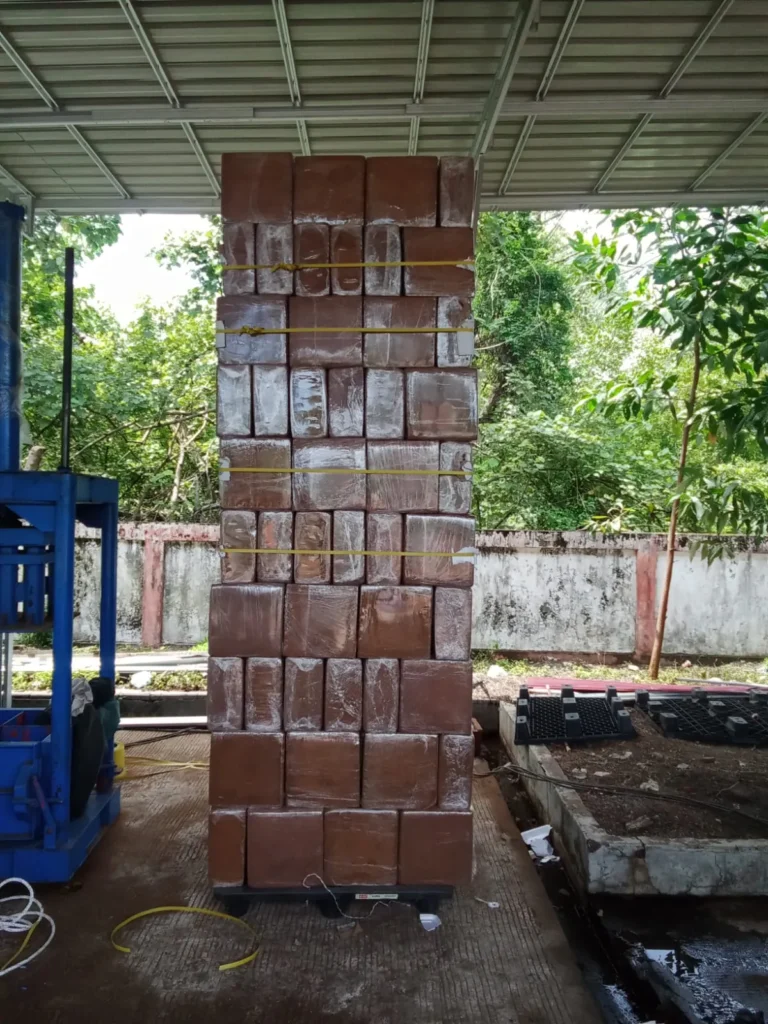
Compressed cocopeat is dense — denser than most buyers expect — which means container loads are usually weight-limited, not space-limited. A standard 20ft container typically takes somewhere around 18 to 20 metric tons of compressed 5kg blocks before it hits the weight ceiling, with plenty of physical space left unused. A 40ft HQ container runs closer to 24 to 26 metric tons for the same reason.
Take that Surabaya quote of $475/MT FOB on a 1×40ft HQ container. At roughly 25 MT per container, that’s somewhere in the neighborhood of $11,000 to $12,000 for a full container load — before freight, before insurance, just the product at the dock. That’s the kind of back-of-envelope math every buyer should be doing before a quote even arrives, so a number doesn’t feel high or low in a vacuum.
Scale that up and the arithmetic gets interesting. At 10 containers a month — which is what we run at CelebesAgro across our product lines — you’re looking at roughly 200 to 250 metric tons of material moving every month. That’s not a figure pulled from a brochure. It’s just a standard container load multiplied by a shipping schedule, which is the same math any buyer can run on any supplier’s stated capacity to sanity-check whether “we ship container-scale volumes” is actually true or just a line on a website.
Why Quoted Prices Can Vary by 2–3x Between Suppliers
Here’s the part most price guides skip: the biggest driver of price variation isn’t the market, it’s where the material comes from before it reaches the exporter.
A lot of cocopeat on the export market is blended. An exporter buys partially processed husk or raw cocopeat from a patchwork of small local processors, mixes it to hit a rough spec, and ships it under one label. The problem is that “rough spec” is the operative phrase — EC and moisture readings can swing from batch to batch, even bag to bag, because the raw material itself was never consistent going in. Buyers who’ve had one shipment test clean and the next test high on EC have usually run into exactly this.
We don’t do that. CelebesAgro controls cocopeat from husk to finished block through our own 1,300-hectare plantation and a network of verified local partners — not a spot-market blend from whoever had stock that week. It’s the same reason we can commit to 10 containers a month without the “sorry, we’re out this cycle” problem that hits buyers sourcing from smaller patchwork suppliers. You can read more about how that sourcing model works on our cocopeat product page.
That consistency is also exactly why price comparisons across suppliers can mislead you. A $0.45/kg quote from a blended-source trader and a $0.60/kg quote from a vertically integrated producer aren’t competing on the same axis — one is pricing a commodity, the other is pricing a predictable spec. If your downstream process depends on EC staying inside a tight band shipment after shipment, the cheaper number isn’t actually cheaper once you factor in the batches you’ll reject.
Reading the Spec Behind the Price
Before you lock in a quote, ask what EC and pH range the supplier is actually hitting. The commonly cited industry benchmark for export-grade cocopeat is EC under 0.5 mS/cm and pH between 5.5 and 6.8 — numbers worth asking for by name, because a supplier who can quote them without checking usually tests consistently, and one who can’t usually doesn’t. We covered how to read a full cocopeat spec sheet, EC and pH included, in our supplier-selection guide — worth a read if a quote has come in and you’re not sure what questions to ask next.
Export paperwork matters here too, even though it doesn’t show up as a line item on the price quote. If you’re importing into a market that requires a Sucofindo inspection certificate or other export documentation, factor the lead time into your sourcing timeline — not the cost, but the schedule. We’ve laid out exactly what’s needed in our cocopeat import certificates guide.

Why CelebesAgro Prices Are Quote-Based, Not Listed
Our cocopeat product page says “available upon request” instead of a number, and that’s deliberate rather than evasive. EC grade, block format, destination port, and container count all move the final price enough that a single listed figure would be wrong for most buyers who read it. A buyer ordering low-EC 5kg blocks FOB Semarang at 40 MT a month is paying a different number than one ordering loose bulk CIF to a different port at half the volume — publishing one price would mean lying to one of them.
What we can commit to without a quote: Sucofindo-inspected material, sourced through our own plantation rather than a trader’s blend, at a scale that supports 10 containers a month without the volume gaps smaller suppliers run into.
If you want a number, send us your spec — EC target, block or loose, destination port, and rough volume — and we’ll quote against it directly. Message us on WhatsApp and we’ll get you a real number, not a range pulled from someone else’s listing.